3 Ways to Explain Team Transformation (So People Actually Buy In)

Organizations spend millions of dollars every year on transformation initiatives, yet research consistently shows that many fail to achieve their intended outcomes. The reason is rarely the strategy itself.
More often, transformations struggle because leaders focus on implementing change before creating understanding. Teams are asked to adopt new priorities, processes, and ways of working without a clear connection to the business challenge, their own success, or the future the organization is trying to create.
The good news is that gaining buy-in doesn't require more communication, it requires better communication.
Here are three research-backed ways leaders can explain transformation in a way that builds alignment, engagement, and commitment.
1. Start with the Problem, Not the Solution
Harvard Business School professor John Kotter found that successful transformations begin by creating a shared understanding of the challenge or opportunity facing the organization. People are far more likely to support change when they understand why it is necessary.
Before introducing a new operating model, process, or initiative, explain the business problem it is designed to solve.
Focus on:
The challenges the organization is facing today
The risks of maintaining the status quo
The opportunities that could be unlocked through change
Why action is needed now
When people understand the problem, they are much more likely to support the solution.
2. Connect Transformation to What People Care About
Research from Harvard Business School professor Teresa Amabile shows that people are most motivated when they can make meaningful progress in their work. Employees are more likely to engage with change when they understand how it will help them be more effective and successful.
Rather than focusing only on organizational benefits, explain how the transformation will improve the day-to-day experience of the team.
Highlight:
Greater clarity on priorities
Faster decisions and reduced delays
Less duplication and rework
More time spent on meaningful work
People don't buy into transformation because it benefits the business, they buy in because they can see how it helps them succeed.
3. Paint a Clear Picture of the Future
Research on transformational leadership from Harvard Kennedy School and other leading institutions shows that a compelling vision is one of the strongest predictors of engagement and commitment during periods of change.
People need to understand what success looks like not just what is changing.
Help your team visualize:
What will be different six months from now
How teams will work together more effectively
How decisions will be made faster
What success will look and feel like
People are far more likely to embrace change when they can see the future they are helping to create.
Many transformation efforts struggle not because the strategy is flawed, but because people never fully understand the reason for the change, how it connects to business priorities, or what success looks like. When leaders fail to create clarity and buy-in, the costs can be significant: slower execution, competing priorities, increased resistance, change fatigue, lower engagement, and investments that fall short of delivering their intended results.
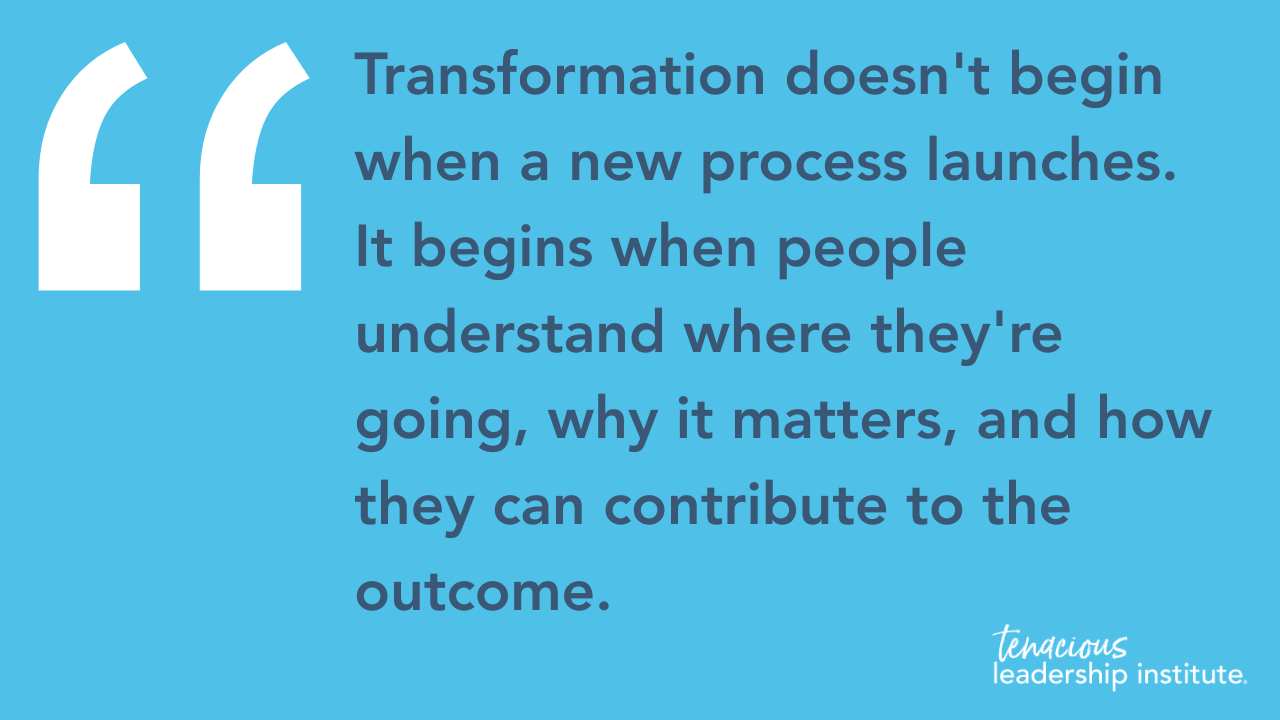
Transformation succeeds when people understand the challenge, believe in the future being created, and see how they can contribute to the outcome.
The most effective leaders recognize that transformation is ultimately a leadership challenge, not a project management challenge. They build alignment before asking for execution and create commitment before expecting adoption.
At TLI, we help executive teams accelerate transformation through consulting, leadership alignment, and executive coaching that turns strategy into sustainable results. Because the quality of your transformation will always be limited by the quality of alignment behind it and organizations that get alignment right move faster, execute better, and achieve lasting change.
Executive Coaching for Leaders Navigating Complexity and Change
Today’s executives are expected to create alignment, drive performance, lead transformation, and maintain trust, often while operating under intense pressure themselves.
Our Executive Coaching programs help leaders strengthen influence, communicate more effectively during uncertainty, increase strategic leadership capacity, and create organizational movement without generating unnecessary resistance or burnout.
Using neuroscience-informed leadership development, practical execution frameworks, and two decades of experience supporting senior leaders globally, we help executives elevate both leadership effectiveness and organizational impact.
If you are ready to strengthen how you lead through complexity and change, we would love to support you.
Leadership Practice
The Transformation Story Test
Before your next team meeting, transformation update, or leadership communication, take five minutes to test the story you're telling.
Ask yourself:
1. Have I Clearly Defined the Problem?
Can my team explain:
What challenge we're trying to solve?
Why the current approach is no longer sufficient?
Why this change matters now?
2. Have I Connected the Change to Their Success?
Can people see how the transformation will:
Reduce friction?
Improve clarity?
Increase effectiveness?
Help them do their best work?
3. Have I Painted a Compelling Future?
Can my team visualize what success looks like?
Can they describe:
How decisions will improve?
How collaboration will improve?
What will feel different six months from now?
Author
Athena Williams, Founder and CEO of Tenacious Leadership Institute, partners with senior leaders and organizations navigating complex transformation at scale. For more than two decades, she has supported executives at global companies including Fortune 500 and high-growth organizations to strengthen leadership capacity, accelerate transformation, and deliver results that hold under pressure.
Her work sits at the intersection of neuroscience, leadership behavior, and execution - helping leaders think clearly in complexity, lead decisively through disruption, and align teams and organizations during critical inflection points. Through executive coaching and leadership development programs, Athena supports transformation that shows up in stronger decisions, sharper execution, and sustained performance across people, teams, and the enterprise.
Take the next step in strengthening how you lead transformation.