Five Markers of True Resilience in Disruption

Resilience is often misunderstood in leadership. It is not endurance. It is not pushing harder. And it is not staying calm on the surface while everything tightens underneath.
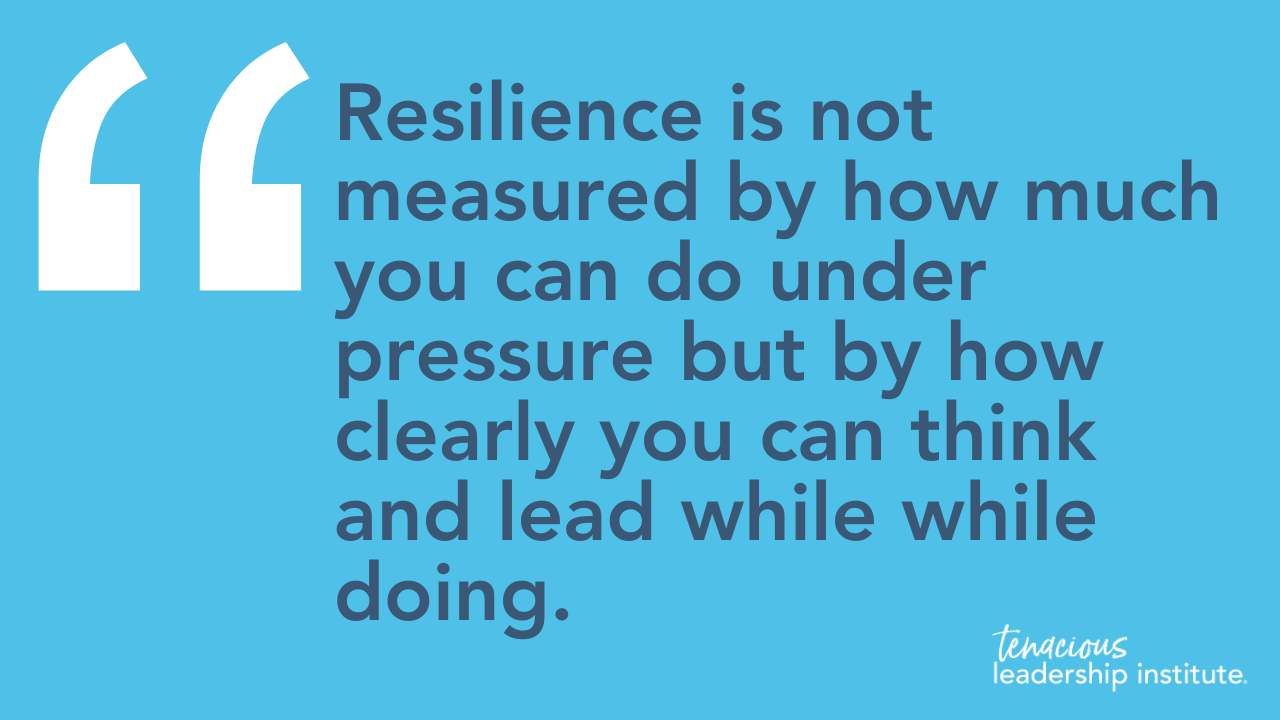
From a neuroscience perspective, resilience is your capacity to regulate your internal state while maintaining clear thinking, relational awareness, and forward movement under pressure. It is what allows your prefrontal cortex to stay online when disruption hits, rather than defaulting to threat-based patterns.
Here are five markers to help you assess whether your resilience is real or performative:
1. Your decision-making gets clearer, not faster
When you are operating from true resilience, you are not rushing to relieve pressure. You are creating just enough space to see what actually matters. Reactive leaders speed up decisions to escape discomfort; resilient leaders slow down just enough to increase precision, which leads to better outcomes over time.
2. Your emotional range stays accessible
Resilience does not mean being steady all the time. It means you can feel frustration, uncertainty, or pressure without becoming consumed by it. If your emotional range narrows to urgency, control, or detachment during disruption, that is not resilience, it is protection.
3. Your team becomes more capable, not more dependent
One of the clearest signals of real resilience is what happens around you. If your team is escalating more, waiting for direction, or hesitating to act, your “resilience” may actually be creating pressure. True resilience expands capacity in others, it does not concentrate it at the top.
4. You can hold competing truths without forcing closure
Disruption brings complexity. Resilient leaders can hold tension, multiple perspectives, and incomplete information without rushing to simplify too early. If you feel the need to quickly “land the plane” on every issue, you may be prioritizing certainty over effectiveness.
5. You recover quickly, without carrying residue forward
It is not about avoiding stress, it is about how quickly you reset. If a difficult meeting or decision lingers in your system and shapes how you show up hours or days later, that residue compounds. Resilient leaders process, reset, and re-enter the next moment with clarity.
False resilience is costly, and the impact is often hidden until it compounds. It shows up in subtle ways at first: slower decision velocity, teams that hesitate instead of act, and a quiet erosion of trust as people experience inconsistency between what is said and how leaders show up under pressure.
Over time, it becomes more tangible, missed opportunities, stalled innovation, disengaged talent, and results that require more effort to sustain. What looks like strength on the surface can quietly drain the very capacity your organization needs to move forward.
This is where the right level of support matters. At TLI, executive coaching is designed to help you build true resilience at the level it actually operates, your thinking, your nervous system, and your leadership behavior in real time. Through targeted conversations, applied frameworks, and in-the-moment recalibration, you develop the ability to lead with clarity, expand capacity in your team, and move through disruption without carrying unnecessary cost. If you are ready to strengthen how you lead when it matters most, executive coaching creates the space to do that work with precision and intention.
Win in Uncertainty: Build the Innovation Discipline That Moves You Ahead
Uncertainty does not slow organizations down equally. Some stall, second-guess, and lose momentum. Others use the same conditions to sharpen their thinking, move faster, and outperform.
The difference is not strategy. It is how leaders see what is actually happening, challenge assumptions, and turn insight into action.
The Innovate for Growth™ 30-day program is designed to help you do exactly that.
In just 10 minutes a day, you will strengthen your ability to cut through noise, identify real opportunities, and create consistent forward movement across your team. You will build the discipline of innovation as a leadership practice, not a one-time initiative.
This is how leaders win in uncertainty: not by waiting for clarity, but by creating it.
Start building your innovation discipline today.
Leadership Practice
Assess Your Reality, Not Your Intention
This week, take one hour with your leadership team and ask:
Where are we seeing signs of true resilience?
Where are we seeing endurance disguised as resilience?
Which of these five markers is currently weakest for us?
What is the cost if we do not address it in the next 90 days?
Then identify one specific shift you will make immediately, whether in how you communicate, make decisions, or manage team energy.
Resilience is not a mindset.
It is a set of observable leadership behaviors.
Author
Athena Williams, Founder and CEO of Tenacious Leadership Institute, partners with senior leaders and organizations navigating complex transformation at scale. For more than two decades, she has supported executives at global companies including Fortune 500 and high-growth organizations to strengthen leadership capacity, accelerate transformation, and deliver results that hold under pressure.
Her work sits at the intersection of neuroscience, leadership behavior, and execution - helping leaders think clearly in complexity, lead decisively through disruption, and align teams and organizations during critical inflection points. Through executive coaching and leadership development programs, Athena supports transformation that shows up in stronger decisions, sharper execution, and sustained performance across people, teams, and the enterprise.
Take the next step in strengthening how you lead transformation.